Water Pressure Repairs
Faerie Glen
Water pressure repairs in Faerie Glen begin with a gauge, because a weak shower here can be the City’s supply, a pressure valve, a half-closed stopcock or old pipe. Readings at the meter and at the tap decide which, and only that part gets priced. A hidden leak is ruled out too.

Weak pressure, from the street to the shower head
Where the weakness shows up narrows it down before any tool comes out.
Every tap in the house is weak
When the whole house is down, the cause sits upstream: the City’s supply, the main isolating valve, a pressure reducing valve or the pipe from the meter. A reading at the meter separates the City’s side from yours.
One tap or shower is weak
A single weak outlet usually means a blocked aerator, a clogged shower head or a valve that is not fully open. SANS 10252-1 says isolating valves must not be used to restrict flow, and a half-closed one does exactly that.
Hot is weaker than cold
The geyser’s pressure control valve drops the supply to the geyser’s rating, and those valves come in ratings such as 400 and 600 kPa. A failing valve, or one that does not match the system, leaves the hot side weaker than the cold.
Spluttering after the water came back
Air drawn into the pipes during an outage comes out in bursts when supply returns. SANS 10252-1 fills an installation slowly with the highest outlet open so the air can escape, and the same method clears it afterwards.
A new shower head made it worse
SANS 10252-1 gives water-saving shower heads a design flow pressure of 50 to 100 kPa, against 20 to 50 kPa for a standard head. On a weak supply, a water-saving head can feel like a fault in the plumbing.
Pressure that fades year after year
Old galvanised supply pipe can corrode from the inside and slowly narrow the bore. Older houses may still have some of it, so an inspection confirms what the pipe actually is before anyone suggests replacing it.
Faerie Glen sits on six supply points, and the high-lying ones recover last
Residents ask in local groups whether anyone else has low pressure, and the answer is often yes, for reasons written down in the City’s own notices. A City statement of 22 May 2025 lists Faerie Glen under six separate supply points: the Parkmore high-level and low-level reservoirs, the Koedoesnek high-level and low-level reservoirs, Mooikloof Reservoir and the Midas and Leander meters.
Each of those zones fills and drains on its own timetable. When Rand Water stops pumping, the City has warned that “high-lying reservoirs will be the last to receive water and recover to acceptable levels”. After the supply recovered in June 2026 it said some residents could keep reduced pressure, “particularly in higher-lying areas and tower-fed zones”. Two Faerie Glen streets on different zones can have different pressure on the same afternoon.
The by-laws do not promise anything better. Section 20(1)(b) of the City’s water supply by-laws says that supplying water is no undertaking to maintain “a specific pressure or rate of flow”. Section 20(3) then puts the onus on an owner who needs a particular standard to make provision for it in their own installation.
There is one tool most owners never hear about. Under section 17, an owner can apply, and pay the applicable charge, for the City to measure the pressure at the premises over a period the owner chooses. That turns an argument about whether the street is weak into a reading on paper.
Inside the boundary the rules are just as specific. A booster pump may not pull straight from the municipal main: SANS 10252-1 puts a storage tank between them, holding at least a quarter of the daily demand or an hour of pumping, whichever is more. At the other extreme, static pressure at any tap may not exceed 600 kPa, so a supply that runs high needs a pressure reducing valve.
Get a reading at the meter before paying for a pump, a valve or new pipe. When the City side is low, the answer is storage, not a bigger pump on the main.
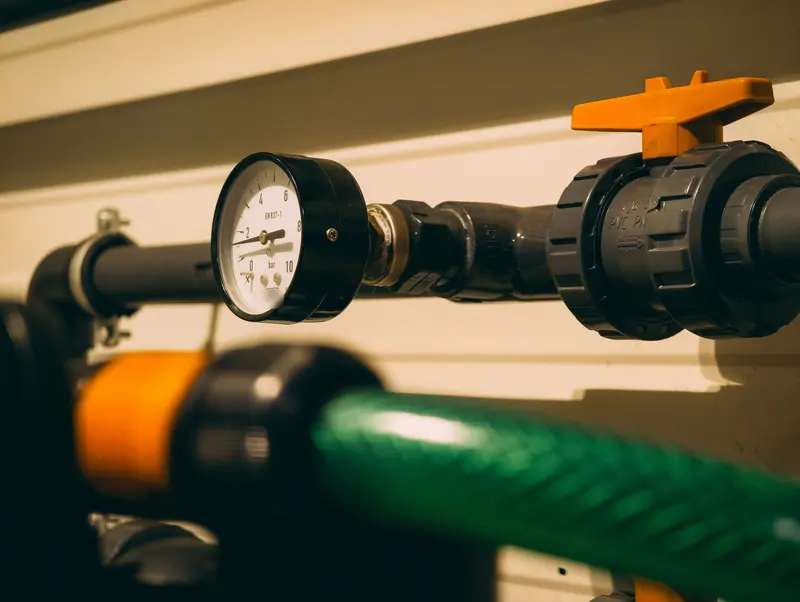
How a pressure fault is diagnosed
So the fix lands on the actual cause.
-
Readings before recommendations
Pressure is measured at the meter and at the weak outlet. The difference between the two readings points to where the loss happens.
-
Valves checked for position and rating
Stopcocks, isolators and the geyser’s pressure control valve are checked before any part is replaced.
-
A booster only where it is the answer
Where a booster is the answer, it draws from a correctly sized tank and never straight from the City’s main.
-
The numbers come with the quote
You see the readings alongside the price, so the decision rests on measurements rather than a sales pitch.
Measure, find the restriction, fix only that
A gauge reading comes before any part is suggested.
-
Describe the pattern
Whole house or one tap, hot or cold, all the time or only after outages.
-
Measure and trace
Gauge readings at the meter and indoors, then the valves, aerators and the pressure control valve are checked in turn.
-
Repair and re-test
The faulty part is replaced or the restriction cleared, and the pressure is read again to show the difference.
Water pressure questions
How to tell where the problem sits, and what fixing it costs.
How much does a water pressure repair cost in Faerie Glen?
How can I check my own water pressure?
Do I need a tank and booster pump for water outages?
Can a pump be fitted straight onto the municipal main?
Will a water-saving shower head fix weak pressure?
What is normal water pressure for a house?
Why is next door fine while my pressure is low?
In a complex, who fixes low pressure?
Request a pressure check in Faerie Glen
Say where the pressure is weak and since when. The reply books a time to take the readings.
Where we work
- Faerie Glen
- Garsfontein
- Lynnwood Glen
- Moreleta Park
- Lynnwood
- Lynnwood Ridge
- Lynnwood Park
- Die Wilgers
- Equestria
- Wapadrand
- Olympus
- Constantia Park
- Waterkloof Glen
- Menlyn
- Silver Lakes
- Mooikloof
- Woodhill
- Murrayfield